[00:00:02] Speaker A: Welcome to the Emerging Minds Podcast.
[00:00:07] Speaker B: Hello, and welcome to the podcast.
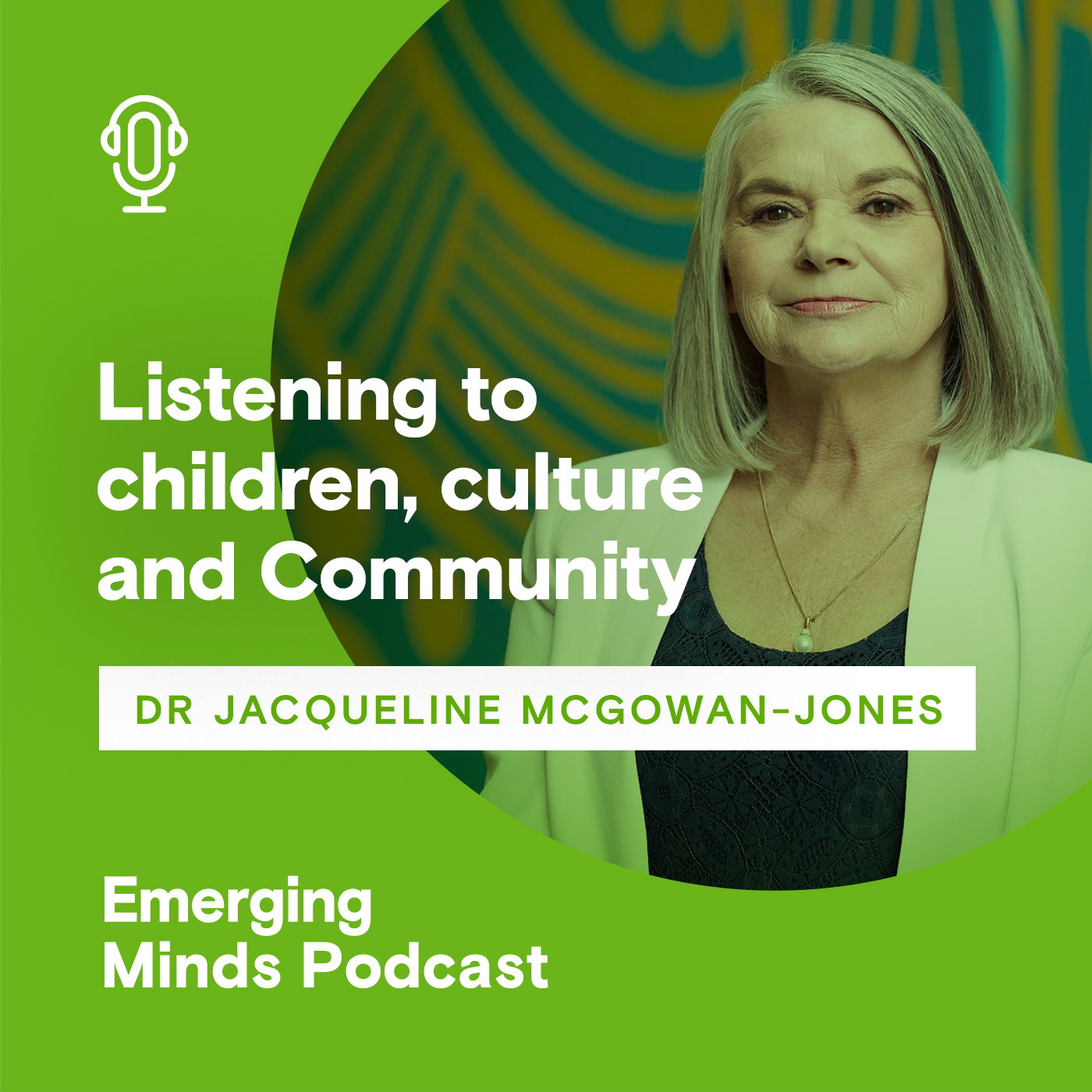
Hi, I'm Nancy Jeffrey, a proud Wulwunga descendant from the Northern Territory. I would like to welcome you all to the Emerging Minds Podcast. Before we start today's episode, I would like to pay my respect to the traditional custodians of the lands on which this podcast was recorded. I would also like to pay my respects to all Aboriginal and Torres Strait Islander people and to elders, past and present, and all the young ones who will one day take on the role of an elder. Today I'm joined by Dr. Jacqueline McGowan Jones, Commissioner for Children and Young People in Western Australia. Together, we'll yarn about the importance of listening to children, the role of culture, family and community in wellbeing, and what culturally safe practice looks like when working alongside Aboriginal and Torres Strait Islander children and families. Jacqueline brings a wealth of experience across education, child protection and Indigenous affairs, and shares powerful insights about relationships, deep listening, and creating systems that help children and young people thrive.
[00:01:12] Speaker C: Could you share a little bit about your journey and what has shaped your commitment to advocating for Aboriginal and Torres Strait Islander young people and families?
[00:01:21] Speaker D: Well, my journey, Third generation, stolen generation, amazing mum who kept us grounded in culture. Well, my dad was often at Her Majesty's pleasure. I'm the eldest, so, you know, I was always sort of like another adult in the family caring for the other kids. And I think that just sticks with you, you know, that our kids culturally are our most important part of our community with our elders. And I sort of had a career that I fell into things, you know, but I never said no. But at the heart of it all was always that cultural connection about the importance of our kids and in family and culture and community. And then as I got progressed in my career, I was able to make choices that more aligned to things I was passionate about. So working in Atsikin, the Bring Them Home Task Force, doing social justice in that seat, working in. In child protection, trying to change a system from the inside, heading up Aboriginal education. They were all about kids. They're all about how do we make sure our kids have a better future. And then home in Darwin, I wasn't leaving. I was happy. And this job was advertised and I thought, oh, I don't want to live in Perth, but, gosh, that's my dream job, being the Commissioner for Children and Young People and making sure that their voices were what we were putting forward.
Not what old girl here thinks, but what do the children and young people think. And so here I am in your
[00:02:56] Speaker C: role as commissioner, you've spoken strongly about children and young people having a voice across government. What are you hearing most clearly from children and young people about what they need to feel safe, supported and heard?
[00:03:08] Speaker D: Well, I think what comes out, even if they don't use the exact words, is they need a system that is holistic, that they don't have to try and navigate to find the right place or the right service or who's going to help them with something. Key issues are limited access to services, especially health and mental health. You know, an education system that they. There's still a lot of bullying and we've got a new national framework for bullying in schools. But frameworks and strategies are all great. It's how the rubber hits the road. And the other thing is, we don't engage the kids in the discussion and we think of all these great strategies and frameworks, but where's the implementation plan and where is the voices of the children about what they think will work? You know, kids also really worried about the environment.
And, you know, we saw last week thousands of kids around the country standing up against racism that incorporated not just Aboriginal children and young people, not just multicultural children and young people, but young people who are really concerned about a narrative that is not inclusive. These young people are now showing us that, well, no one's listening to us, so we're going to protest. And listening to them is so important.
[00:04:27] Speaker C: Absolutely. So when we talk about meaningful listening, especially with Aboriginal and Torres Strait Islander children and families, what does that look like in practice? How do adults make children's voices and not just collected, but generally respected and acted on?
[00:04:45] Speaker D: So, for me, the first thing is, if we're engaging with our kids, Aboriginal and Torres Strait kids, then we have an inbuilt distrust of systems, and that's because of historical actions. So we need to say. We don't say, oh, we're coming for an hour, we want you to tell us our last story. You know, like, that's not going to happen and you can get offended when they think you're a white fellow, you know, but that's not going to help anyone. But, you know, I did, for example, in a regional community, I said, I want to talk to kids that aren't going to school.
And so I rang a couple of the elders I know in that community who are engaged in organisations that are working with some of the most vulnerable, the kids who are homeless, who are sleeping rough, the kids who are not engaged in education, the kids who are suffering poverty, the kids who have been in Detention.
And I said I wanted to yarn with those kids, can you help me? Now the first thing I gotta say, M.K. i love her but the first thing she said is she not a gurria, she one of us, she's auntie.
Now I could be offended but you know, our people know what to say to say to our kids. She's safe to talk to. And that was a couple of years ago and just a couple of weeks ago I was in that same location and that elder was telling other people, see she come here, she meant it, she talked about it, now she's back telling us what they did. So you have to have the right heart to do this.
You have to have time, you need to recognize that, you have to show who you are. And you know what our kids are so quick to pick up if you're not genuine, you know, they are smart and they won't engage, you know, and, and of course I brought a feed cause it was early morning, we wanted these kids in early. So you know, I bought a big feed and, and I didn't say, oh you can have an apple and a banana and one cookie, you know, just put a big feed in the middle of the room and help yourself. So you have to look at, what is it that you want to do? You have to look at, why do you want to do it?
Because the kids want to know that they're not just talking to you so you can tick the box and say, well I went and spoke to Aboriginal kids. So we do a child friendly copy of every report we do, we take it back to those kids. When I did the Banksia Hill inquiry, we went back out to Bankseer Hill, then they were fighting over whose quota it was we used in the report. He goes, why haven't you got my name there? I said that and I said, but they've told you it's confidential, remember? But you have to build relationships and you can't do that in an hour's visit, you can't do that in one visit. In saying, right, I've got these 10 questions and I'd like you to answer them for me. You have to let the children and young people lead that conversation and then you can say, okay, so you don't feel safe because there's not straight lines. What else doesn't make you feel safe? And start to stretch it out a bit. You need to ask those delving questions and give them an opportunity and you have to sit and listen, you know that we think, we sit, you think a bit more.
How much do we want to say what's the thing we really want to say? Do we want to say it?
So you have to sit in that silence.
I love that.
[00:08:01] Speaker C: That silence is so, so important, isn't it?
[00:08:05] Speaker B: And people don't.
[00:08:06] Speaker C: A lot of people don't understand that. Let's talk about the whole child and not just what's happening for them individually and you've touched a little bit on it, but who surrounds them and what they're connected to.
What role do family, kinship, community, country and culture play in the social and emotional wellbeing of Aboriginal and Torres Strait Islander children?
[00:08:27] Speaker D: Every single bit of that is critical for a child. You know, I've got a mug here and it quotes Andrew Jacamos.
Culture is not a perk for an Aboriginal child. It is a lifeline. It's my favourite mug. Love is about the whole child and it's part of the thing I say when I'm talking with government and service providers. I can't rip off an arm to go to the physio and the head to go to the neurodevelopmental psychiatrist and the stomach to go for the poverty place to get it fed. You've got to look at the whole of the child and the whole of the child. For an Aboriginal child, but are you a glycerini child is about our whole ecosystem, you know, our nannies, even when they're bossing us, and now we're the nannies, right?
And we do it. And nanas, when they're bossing us, even at our way down, nanas are still bossing us. Our cousin sisters who have expectations of us as the other mothers of our children, our connection and knowing where we fit. Knowing who you are and where you fit. I speak to so many young Aboriginal children, especially in detention, who might say to me, oh, I'm Noongar, and I say, oh, what's your name? And then I might say, oh, so your family's from Jordan? Yeah. I say, well, that's Yamaji country.
Ngma Noongar, Miss. I live in Perth. They're so disconnected from where they belong and who they are and that no one likes to know that. I mean, we talk about this with kids who were adopted, Remember in the forced adoptions, all those single mums about the trauma that caused those children when they found out they were adopted. Nothing was as it seemed, and kids who knew they didn't fit but didn't know why.
So that's why I say it's not just about our kids, but connection to our culture. And our community, our family, our belief systems, our knowledge systems, that's what makes you strong.
And when it's no point saying, if I hear this again, well, you know, that community is so down and out and da, da, da, da, da, well, get in and work with that community to support them, to support their kids, to be safe at home, to grow up strong in culture, to value who they are.
[00:10:54] Speaker C: Very important words there, Jackie. And you know, the systems are what lets a lot of our kids down and our families in the Aboriginal and Torres Strait Islander communities. But for practitioners who may be walking alongside families, what are some of the most important things they need to understand before they begin offering support? And you did mention listening and time, but there are some more things in there.
[00:11:19] Speaker D: I know, look, they have to build that relationship so they fully understand and get families to be able to identify what they need, what's working well, what's not working so well, and what do they need?
Because any one of us, if someone says, well, what you need is to go to school and get a qualification, we're not going to listen to that. If we're not in a space to be thinking about education, if we're hungry or if the world just seems too much for us, the world's just too loud, it's too much. So relationships, relationships, relationships, nothing replaces that. Now that does take sitting in the silence, that does take deep listening, that does take time. But also find out about the people and where they're from and what's happened for them before.
You know, I can remember saying to social workers going out to remote communities for child protection because often it's their first year. Right. And I'd say, so where did you grow up? Like how many in your family? I've got two brothers. Oh, okay. And did you reach up your own bedrooms? Oh yeah, we had a four bedroom house. And you know, was there a TV in each room and well, not all rooms, but there were two TVs. And yeah, we have our own devices and you know, we got this lovely house, two motor cars. And I said, so when you get out to that community, you have to take away your cultural norms and not judgments of poverty, of neglect, which are actually in fact based on poverty. So you're going to walk into the house, you're going to open the wire fronted cupboards that have got nothing in them or they've got padlocks on and you're going to say, oh, they're not feeding the children.
But did you notice there's no fridge? Because the fridge cost about eight grand and then it's about eight grand in freight.
So there is no fridge. So. So that family actually goes to community store every morning and at lunchtime and in the afternoon. And if Nana's looking after eight or nine kids, another reason she might not keep a lot of food in the house is she can't afford to be feeding others when she's looking after those little ones. So she would culturally would be required to feed others. So stop looking at it with what you know about your life and learn about what does it mean to live in a different way and just being
[00:13:48] Speaker C: curious and, you know, being in that moment of, you know, being curious about the community and the child itself. So just on that, you led work on the Aboriginal cultural safety framework for culturally responsive schools. From your perspective, what does cultural safety mean in practice for children, families and the people who support them?
[00:14:09] Speaker D: So if I use education as the example, what we are saying is the school is a community.
It is not teachers and students, it is a community. And for a school to be effective, we need everybody to be engaged in that community system.
That's parents, that's families, that's other services. And that's about true engagement. Not just Gam and I, we've got an elders council and they meet over there in that yarning circle once a month.
This is about how you embed this as a practice in your organisation. So if we start with cultural awareness, which, heaven's sakes, we shouldn't be doing that anymore. We've been doing it for 50 years and if you don't know we're here, then there's something wrong. We're here and we're here to stay. We've been here before you were, and we'll be hereafter. The next stage is around making sure children are welcome in the school. But that means you have to engage their families, because if the family's not welcome and the family don't feel connected, then they're not going to see the need for a child to be connected to a school system. Our kids need to see themselves reflected. We must have high expectations for Aboriginal people. You know, over the years, I've been really in two minds about identified positions because often we put somebody in a position who's not ready for that position because we just need to fill it with an Aboriginal person and we set that Aboriginal person up to fail and the system up to fail. But we do need identified positions so that organisations have a responsibility.
But it can be really challenging if we're just giving it lip Service, the same in any service.
Having an Aboriginal person and making them responsible for everything Aboriginal. And you see this often in the education system. For example, the Aboriginal and Islander education officer or Yunnanu teacher. I'm a new teacher. It's like that kid's running Amart. Can you go and sort them out or no? This is about building the capacity of the system, the whole of the system. This is about saying we are all responsible for what outcomes happen for every child and young person in our service.
And so to be culturally safe, you don't just have an Aboriginal person or design an Aboriginal T shirt for your staff to wear. That was whether I was running an acco in government, state authority, disability service, no matter.
Because I'm there to do a job and I wear the clothes I think represent the role I should be presenting. Now don't get me wrong, I don't wear my high heels out in remote communities. But it is about changing the whole ethos. It is about a willingness to learn from Aboriginal staff, a willingness to step into that space and listen. Cultural safety means that you are prepared to suspend your views and listen and hear. Don't listen to reply, listen to hear.
[00:17:09] Speaker A: The Emerging Minds 2026 National Workforce Survey for Child, Parent and Family Mental Health is closing soon and we want to hear from you. We invite practitioners, leaders, educators, researchers and policy makers across every region, discipline and service setting to complete the survey. Your response will help shape support for children and their families across Australia.
You have until Monday 30th November 2026 to have your say. So what are you waiting for? Head to our website
[email protected].
[00:17:46] Speaker C: So you know what gives you hope when you think about the future for Aboriginal and Torres Strait Islander children and young people? Jackie.
[00:17:53] Speaker D: Oh, we've got the smartest kids on the planet. Honestly, there is real hope for our kids. The problem for our kids is the broader community not being like our community, which is we are all responsible for our children.
Do you know what I mean? Like, every Australian should be absolutely devastated about what is happening to our children and young people in Australia.
Hundreds of thousands living in poverty, thousands homeless, thousands removed from families because instead of supporting a family to keep their child safe, we take them into a system where they end up worse off. We are so many times not removing to better, you know, so what is the purpose?
And I really hope our society changes. But I'll tell you the other day when all those young people were protesting against racism and targeting a political leader, but the underlying issue was racism, there was an elderly Chinese man standing next to me while I was watching. And when they started their speeches, he turned to me and he said, our future's in good hands.
[00:18:59] Speaker C: Oh, beautiful.
[00:19:01] Speaker D: And it is. I can't wait for the day when Parliament is screaming. You know, you can watch it live if you're that bored or want to say that much bad to the Agya. But I can't wait for the day when I'm watching Parliament screening and there's blue hairstyles and green hairstyles and tattoos and piercings. And our young people are right there and they are the ones showing us how to do this in better ways.
[00:19:26] Speaker C: So as we're coming to the end of our yarn, if you could leave practitioners with one key message about working with Aboriginal and Torres Strait Islander children and families, what would it be?
[00:19:36] Speaker D: Be humble. Leave your bias at the door or your preconceptions. One of the things I remember people used to say to me, I don't know how to speak to an Aboriginal person. So we open your mouth and you use your voice, you know, voice box. But that deep listening, listening to hear, not to reply. You might be engaging with someone sometimes and you look at them and you go, you're thinking about what you're going to say. Right. Make sure you're listening to hear, but also recognise that individually, people know the best things to do.
You're there to support the best things to happen.
[00:20:14] Speaker C: And finally, when you imagine Aboriginal and Torres Strait Islander children growing up strong in culture, identity and wellbeing, what does
[00:20:22] Speaker B: the future look like to you?
[00:20:24] Speaker D: If all our kids could grow up strong in identity, culture, wellbeing, we would say, such a happy community.
There's no doubt at all that when you know who you are, where you belong, how you fit, you are a happier person. And I often say to non Aboriginal people, think about our cultural identity and belonging as our religion.
No matter what religion you're in, you are happy if you are grounded and centered in that belief system.
Yeah.
And I'm not going to tell anyone what belief system to follow, but our belief system, if we're grounded in that, then we are strong and happy and so are our kids.
[00:21:12] Speaker C: Beautiful.
[00:21:13] Speaker B: What a wonderful message to leave them.
[00:21:15] Speaker C: Yeah. Thank you so much.
[00:21:18] Speaker A: Visit our website
[email protected] au you to access a range of resources to assist your practice.
Brought to you by the National Workforce Centre for Child Mental Health, led by Emerging Minds. The centre is funded by the Australian Government Department of Health, Disability and Ageing, under the National Support for Child and youth mental health program.