[00:00:02] Speaker A: Welcome to the Emerging Minds Podcast.
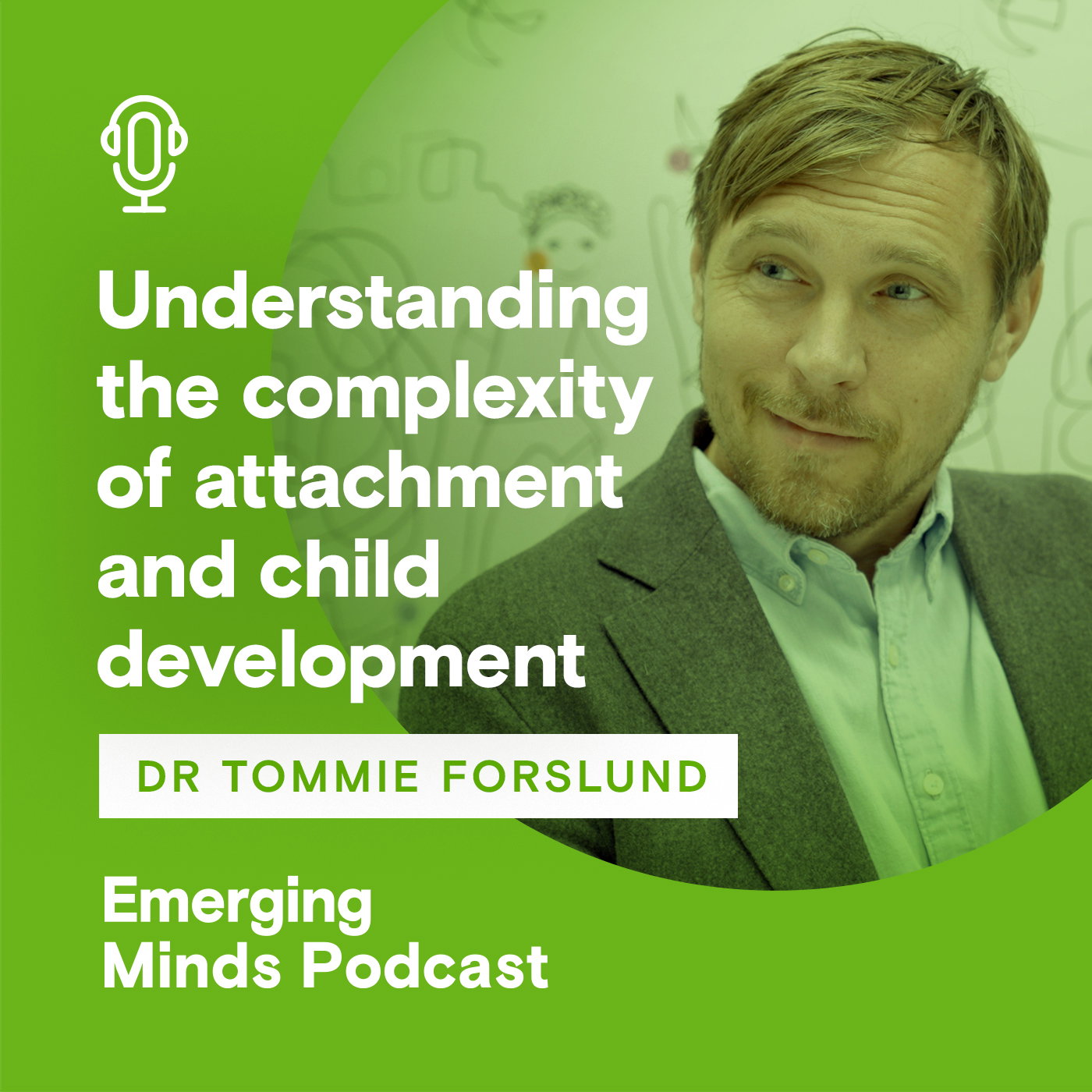
[00:00:07] Speaker B: Hello, I'm Cathy Moore and you're listening to an Emerging Minds podcast. As we start, we'd like to pay respect to the traditional custodians of the land on which this podcast is recorded, the Kaurna people. We also pay respects to all Aboriginal and Torres Strait Islander people, their elders past, present and emerging from different first nations across Australia. I also acknowledge that sovereignty was never ceded. This always was and always will be Aboriginal original land. Today I'm joined by Tommy Forsland, a psychologist and child development researcher from Uppsala in Sweden. Tommy's ongoing research and clinical practice help us to think carefully about how theories can be understood and applied in ways that genuinely support infants, children and families, particularly in complex practice contexts. Tommy's research highlights the importance of using attachment and child development theories carefully and accurately, particularly in legal contexts where misunderstandings can have serious consequences for children and families. His interdisciplinary work connects disciplines, encouraging evidence informed collaborative practice that supports children's wellbeing and keeps their best interests at the centre of decision making. Tommy's focus not only enhances the wellbeing of infants and children, but also promotes more informed and compassionate systems.
Tommy, I'm really curious about your insights and knowledge from research findings about how development happens within the context of relationships. Can you tell me more about that?
[00:01:38] Speaker C: Yeah, I think relationships are crucial for children in so many ways, but perhaps in a more complex way than what people usually think. I'm coming to this from from the perspective of attachment theory. A common misconception is kind of that the attachment quality sort of determines development and that child development is determined to a very notable extent by children's sort of attachment security with their caregivers. There's ample evidence that attachment is important. The importance of children developing and if possible, getting to maintain attachment relationships with their parents. There's also support that if possible, it's good if children can develop secure attachment. But sometimes it's I speak to a lot of parents who are stressed about the children's attachment quality and it's almost as if that is the only driver of child development and that everything that parents do are about influencing their children's attachment quality. So I think it's important to remember that attachment is one important aspect of relational developments, but that parents do so much more. It's still about relationships and what happens within close relationships between children, infants and children and their caregivers. But not everything is influences children's attachment quality, for example, for learning and for security and for development. In many ways children really need Attachment figures. But they also need to sort of support with cognitive development. They need to learn what's right and wrong to support their moral development. They need support for their language development. And a lot of this happens within relationships. But it's not just about children's attachment quality with their parents, with their caregivers.
[00:03:28] Speaker B: Okay, so attachment is one important aspect of early relationships. And at the same time, there are other aspects of relationships that influence early development and being supported with early learning, moral development, language development, within relationships. These are all important aspects of infants experiences. And talking about relationships. Can you explain more about networks of relationships?
[00:03:52] Speaker C: That's also a key thing that a lot of people forget. People often talk about the presumed importance of a primary caregiver. The thought that one close relationship with a caregiver is necessarily more important than other relationships, and that that relationship will influence children's internal working models and how they relate in other close relationships and so forth. But the last couple of decades, attachment research have clearly emphasized that children are prepared to develop attachment networks. That evolution has made us prepared to develop multiple independent attachment relationships. And pertinent research shows that children's attachment quality with respective parent is determined by that respective parent's availability and responsivity, typically caregiver sensitivity. So it's not like the mother's way of responding. The mother's way of being sensitive influences how children are attached to their fathers in heteronormative family constellations. Children's attachment quality with their mothers depend on how the mothers respond to the children, and attachment quality with their fathers depend on how the fathers respond. And if there's an auntie or an uncle or grandparents who are sufficiently continuously present, then children can develop attachment relationships with them too. So children can have a network of attachment relationships. And research also emphasizes that each attachment relationship, for example, comparing attachment quality to mothers and fathers, attachment quality in these relationships have equal importance in child development.
[00:05:32] Speaker B: So children have a number and a network of attachments that are developed through early experiences.
And their development is supported by the network. And then following on from that, the way that caregivers interact and develop those attachment relationships is shaped by their early experiences. Are there different aspects of caregiving that shape the quality of relational connections? Those early attachments?
[00:05:56] Speaker C: There's multiple, multiple layers to that. Research on caregiver sensitivity and caregiver's mentalization emphasizes that our history of receiving care growing up has a notable influence on our ability to provide care for our own children.
When we become caregivers, it's so much easier to give our Children what we have received ourselves. It's so much more difficult if there's something you haven't appreciated and you want to do things differently or there's something you haven't received at all, it's so much more difficult to give that to your children. So you may then. I'm not saying that it's impossible in any way, but you may need to spend a lot more energy on practicing doing things differently. See if you can find other role models, perhaps seek counseling and support. Some parents do that.
[00:06:48] Speaker B: Okay, so sometimes there are barriers or challenges that require additional support and skill building to strengthen early relationship quality.
[00:06:56] Speaker C: I'm thinking about a Danish study that I read and mothers who had had, they had been suffering from psychological ill health, I think, and then had rough childhoods, but their children were nonetheless secure. The mothers were. They were quite stressed and tired and spent, but they were aware of the importance of how they responded to their children's signals. So what I got from the paper was a reading between the lines is like, it's like they really emphasized the importance of being there for their children and being sensitive and working on how they were available and responsive. And they managed in a good enough way notwithstanding like in, despite their, their rough post. But it kind of took a toll on them in terms of their energy levels and because they really needed to sort of work hard on being the, the parent they wanted to be. Whereas it may come much more naturally and, and, and easy for adults for caregivers who have, who have a history of receiving sensitive care.
[00:07:55] Speaker B: So that's really interesting and important research.
Do these kinds of research outcomes highlight the need for additional support to make the difference needed for outcomes to be equitable between different groups of people? And that research shows that the additional support is effective and can make outcomes more fair and even.
[00:08:13] Speaker C: And then there's other layers. Caregivers, mental health. There's tons of studies emphasizing that parental stress and mental health for caregivers influences to what extent we can be available and our responsivity, our energy levels in directing our attention towards our children and their signals, following their lead, being there with them. Another layer is social support.
Do families have support from extended network from their own parents and from friends and the community they're living in.
[00:08:48] Speaker B: So as well as caregivers own experiences, there are current relationships and available supports. And I'm thinking about the caregiver's own attachment relationships and how they continue to influence the network of attachments that are then available to infants and children. And when we think about policies and programs that support children. We need to think about those networks and ways that we can build, support and sustain those networks.
[00:09:13] Speaker C: Yeah, I totally agree. Attachment research emphasizes that it's usually beneficial for children to have multiple attachment relationships. Also, the support that their parents receive can make it easier for their parents to be the parents that they want to be. And what children need and to have additional close relationships with aunties and uncles and grandparents can often be really beneficial in child development.
[00:09:39] Speaker B: And it's within this context that children's cognitive development and their social, emotional well being, their moral development, all aspects progress the best.
[00:09:48] Speaker C: Yes. One thing that like all the developmental psychology that I've read and I'm looking at research, I often feel that people zoom in on one mechanism of learning and developing. Sometimes it's like everything is happening through the relationship. Other scholars may emphasize almost single handedly children's sort of neurological dispositions and genetics. I sometimes feel that we zoom in too much on just one side. Rather than acknowledging the complexity and and all the different sort of learning mechanisms that children have, we're equipped with multiple ways of learning and adapting and and developing like within a relationship. A key thing from attachment theories, the notion of being a secure base and also being a safe haven, being a secure base. I think that facilitates one learning mechanism for children which is their exploration. Drawing from PSG and others kind of the. The drive that we're endowed with in wanting to explore and learn from exploration. That relationship can facilitate to what extent that children feel confident and can relax and go out exploring and learn from exploration.
And I think that can influence often their cognitive development by exploring objects and kind of that in depth exploration. Also influenced by relationships being a safe haven. Then when things happen and children's attachment system is activated and children draw closer to their parents to to get protection and to. And to receive comfort. I think those interactions have a special role in helping children develop emotion regulation in identifying and understanding facial expressions, understanding emotions.
[00:11:47] Speaker D: Do you work in health, education, social or community service sectors? The Emerging Minds 2026 National Workforce Survey for Child, Parent and Family Mental Health is now open. You don't need to work directly with children or specialise in mental health to take part. We want to hear from practitioners and leaders across the country to help build one of Australia's most comprehensive pictures of the workforce supporting children and families. Have your say before Monday 30th of November 2026. Head to our website at emergingminds.com au for all the details.
[00:12:27] Speaker B: Thanks Tomi. That means these attachment concepts of being a Safe haven and secure base are then key to broader development.
[00:12:34] Speaker C: So that's both sort of relationships and attachments being able to influence children's exploration and exploration being one important part of children's development. And that goes beyond attachment relationships. Children explore when they're on their own. They explore when they're at school, when they're with their friends. So I think that agentic exploration is one important thing. Then imitation children watch their caregivers, they watch friends, they see what types of behaviors are successful and leads to good outcomes. So they imitate behaviors. And they also learn from observing their caregivers and others. So I think it's difficult to zoom in on and kind of arguing that, for instance, everything is about. About attachment and how caregivers kind of respond to children's signals when they're vulnerable. It's. It's also supporting children's exploration, like Vygotsky and Scaffolding being there as a teacher to help children. What is a suitably difficult and challenging task? Children seem to thrive when they get to work on things that aren't too easy for them, but not too complex either. How can we give them suitably challenging tasks? And then perhaps if it's almost too difficult, like a puzzle, how can we help them with the frame? How can we help them direct their attention? So I think there's so many developmental mechanisms at the same time. I think we need to remember that. And we shouldn't zoom in too much on one developmental mechanism. But how can we sort of support children in learning in different ways?
[00:14:11] Speaker B: So I'm taking from this that it's really important to understand the range of developmental domains that there are for children and to appreciate the importance of social and emot wellbeing as infants and children progress, and also to understand the interactions and the environments around them and the secure bases and the safe havens that they might have in that network of close relationships. And if we're really focused on supporting infants and children and their families, we need to provide opportunities and supports. And that might require ways that we think about policies, the ways that we think about designing programs. How does that appreciation of the big picture, the whole child with the range of developmental domains and other influences, how should that influence policy and program design? And that might be a big question.
[00:14:56] Speaker C: Again, it is a big question, but we can look at it from different directions.
Attachment theory, modern attachment theory with a focus on attachment networks. It really emphasizes that we should support children in developing and maintaining relationship with multiple close caregivers, if possible. If they have that Opportunity and that policy should include how do we direct resources and make sure that there is support for children in in being able to do so?
I think it includes multiple things like how do we early enough identify and pick up on signs that caregivers and extended network may be suffering from psychological ill health? What about poverty? How. How can we counter poverty to make sure that caregivers can be available? There's a few examples. If, if we think about child protection as one sort of more concrete example, how can we assess the potential for. For the network to be present and to provide support and to be strength for caregivers and children who are struggling? How. How can we try to involve the the network and and support the entire network intending to to a child's needs to perhaps prevent the need to have to place a child in out of home care? The strength of the entire network with multiple important relationships for children. How of course, if a child has to be placed the opportunity to place the child within the network. There's often strengths in the network.
[00:16:32] Speaker B: Do you have examples of programs or approaches that work in this way?
[00:16:36] Speaker C: In Sweden, in my municipality, there's ongoing developmental projects in trying to become even better at using families networks and supporting the entire network.
So perhaps we have a struggling caregiver. What about the relationships with the extended network? Can. Can we improve those relationships? Can we invite the extended network to provide more support, to care even more for the child and to support the parent and to A to prevent out of home placements and also then B of course, if a child has to be placed, can it be placed within the network? Can the network be used to facilitate the parent child reunions for example and to really use that network. And even though I feel like attachment theory has developed quite a bit and we're now focusing on networks individual. The fact that there's independent important attachment relationships simultaneously between children and various caregivers I'm excited to see in the future if we'll be even more inspired also by systems theory and systems reasoning to see what about children sort of maybe internalized representations of the entire system family system's ability to to support them in a sense how their security within their family system.
And so how can we support the entire family system that way?
[00:17:57] Speaker B: So with our thinking, I'm wondering about supporting systems and how we work towards collaborative practice because that might require us as the workforce to be connecting and collaborating across agencies and systems. Do you have a way of thinking about that that's helpful and supportive? And I'm thinking of the work that you do in the Swedish center, the suf?
[00:18:18] Speaker C: Yeah, SUF is a Swedish acronym. It's a resource center that I'm working for within the region. The acronym, if I, if I were to translate it, it would be collaboration, development, parenting. And from. From the workshops now, and having talked to practitioners here in Australia, I feel that there are similarities between Sweden and Australia in. In a perception of carries often fragmented, that different organizations sort of things and organizations can be siloed and it can often be difficult with interagency cooperation. So the families that I focus on, families headed by neurodiverse caregivers, like parents with intellectual disability, autistic parents, parents with adhd, they often tend to have complex needs. When I say often that when, when they're struggling and when they need support, they can often have multiple sort of support needs and it can be complex. These families can thr.
Of course. And there. There are families headed by neurodiverse parents who do not need support, but on the group level they are vulnerable and they often have complex needs.
[00:19:28] Speaker B: So understanding and acknowledging these differences and the ways that environments and services need to respond, that that's important.
[00:19:35] Speaker C: The parents can often be traumatized. They can suffer from psychological ill health at the same time lack social support and lack friends, or have a very limited social network. Their children may be neurodiverse and have needs sort of for adaptations in school. And they're often poor, they often struggle with their finances, with. They often end up being single parents. So they often need support from multiple agencies simultaneously and support must be coordinated. So suf, we're working bottom up. We're funded by the municipalities and by the region, and we've existed for more than 20 years now. And I'm not taking any credit for this. It's the way my colleagues have structured this and set this up. I think it's a good example that we're working bottom up based on practitioners needs.
So there's local groups in each municipality with practitioners from different organizations, and they meet regularly to sort of ponder do we have particular needs for more knowledge, what kinds of adapted methods may we need? And also how can we cooperate in a better way between agencies. And then we support development projects, we disseminate knowledge through workshops and seminars, and we try to support them in finding adapted methods that can be implemented. Or sometimes we support them with their good ideas in how to develop adapted methods as well. So being able to over time, not in a project form that is defunded after a few years, but being cognizant of their opportunities but also their restraints and limitations based on finances and the way the municipality is structured. Being able to sort of be there for them based on their actual needs and being able to provide the best possible support to these families, being able to support them over time in staying up to date and increasing their knowledge, increasing the number of suitable methods that they can work, work with an offer and how they can collaborate over time.
[00:21:45] Speaker B: These aspects of sustained services that are attuned to the needs of infants, children and families, they're so important.
At Emerging Minds, we're advocating for a similar comprehensive and coordinated system.
How do you think that this approach supports practitioners?
[00:22:00] Speaker C: I think such approaches that aren't top down is often useful because the practitioners appreciate that the practitioners can't all be experts in everything. I mean, most practitioners are generalists. They tend to appreciate having champions close by and teams of specialists that they can consult when needed. I don't know what it's like in Australia, but I imagine it's similar to Sweden that they need to be up to date when it comes to questions concerning domestic violence, cultural aspects. And there's so many different questions that comes and goes that there's pressure to stay up to date with. And they can't all be experts in everything, but. So a few practitioners within each organization tend to focus a bit on these families within our organization to sort of keep up to date with that and how they can then disseminate knowledge within their organizations and support their organizations and their colleagues. So working sort of continuously over time like this.
[00:23:02] Speaker B: Tommy, that sounds like a fabulous project where the workers really know the families and really know the families on an individual level. And the workers also know the research, but they know the individual needs of the families. Then they use that knowledge to work with their colleagues and draw upon other colleagues who might have other specialist knowledge and that works together to drive research and share the work together. Everyone has a confidence in a sustained program as well. And I think that knowing that this is not a pilot program that's going to be defunded, it's an ongoing program with those connections that really builds those elements of trust. Trust that's really interesting and really hopeful talking about that program. And I just want to ask a bit more about that program and in other work, how important is it to understand the research or to have a local specialist or a local champion who also understands the research, who we can go to to have those frameworks. But then what do we do with research findings and what's the best way to apply them at an individual level? Does that make sense?
[00:24:01] Speaker C: Yeah, it does. You can talk about out sort of research on at least two different levels. The usual level, when I'm. When I'm doing research and most of my colleagues, we're doing research on a framework level. We're trying to find general principles. We include 100, 200, 500, a thousand individuals. Sometimes this register studies with 20,000 individuals and so forth. We're trying to look at associations on the group level. For instance, going back to attachment theory, is there a theoretically based on Bowlby and Ainsworth and others, sort of looking at the sensitivity hypothesis, there should be a association between caregivers sensitivity towards their children's signals and the children's attachment quality. So we can do research on that with, on the group level with lots and lots of dyads, children and caregivers. And we can corroborate those notions or provide support for that general principle. And that can be really important to influence policy work. If we know that caregivers availability and responsivity is on the group level linked to children's attachment quality, like universally, we can try to, on a policy level, provide guidance to practitioners, we can try to provide knowledge to caregivers. We can design and offer support to caregivers to be able to be available, sensitive towards their children's signals on a group level without needing to assess each and every child's attachment quality. We don't need that on a policy level. In general, we can support families, we can support children through supporting their families and being sensitive.
[00:25:42] Speaker B: So research findings are important to inform policy and program development. But what about for clinical practice where we're working with many different individuals and situations?
[00:25:52] Speaker C: What about then on the group level, that's a good approach to support child development. Then there's another level that some scholars call the diagnostic level. If we want to proceed to try to classify an individual child and its caregiver, if we want to classify on the level of the individual child attachment quality, then suddenly we need assessment methods that have other psychometric properties. On the group level, it's okay if we misclassify a few children as long as on, on the group level it's robust enough to sort of be able to validly and reliably do research on our constructs. But on the level of the individual, it's really important that measures are sensitive, have high sensitivity and high specificity that we're not. For instance, if we want to identify disorganized attachment on the level of the individual, we don't want to miss infants, children who are disorganized. We want the instrument to pick up on and to identify all or the vast majority of disorganized children. Concerning specificity, we don't want to have false alarms either. We don't want to sort of scare parents that your child is disorganized when the child isn't disorganized. And there has been a discussion about these things. I have colleagues who've written multiple papers about that. For instance, a few decades ago there was some proponents in the UK that that we should screen all children for disorganized attachment and to use that in child protection, sort of. But the attachment community has really emphasized that on the level of the individual, our instruments don't have sufficient sensitivity and specificity for, for being used on that level. The risk is too high for false positives. Children may behave in ways that fit our criteria for disor or for general insecurity, but it may not have anything to do with the relational history with their individual caregiver. It can be signs of neurodiversity. They can be overstressed. The assessment may not be culturally appropriate given the culture that the infant and caregiver comes from. There can be so many issues on the level of the individual with these measures. On the framework level, practitioners can really use group based research to kind of guide them.
It's generally important that caregivers provide sensitive caregiving and we can support them in, in that way on the level of, of the individual to be careful in that sort of overuse group based assessment methods and, and to not sort of infer too much from individual children's behavior because individual children may or may not be a good example of a general principle.
[00:28:41] Speaker B: Thanks, Tommy. I'm making sense of this and how the research and the cumulative research over decades really helps us to understand children on a whole and to think about how we work and the programs that we design and the policies and conditions that we set up. But when we're working with individual children and families, it's really important that we get to know this child in this family and this context and that we're holding those frameworks not necessarily lightly, but we hold them with care and that we're aware of the limitations of measures. So we're aware of issues like specificity and sensitivity around measures, but also what are the interpretations?
And to make helpful interpretations of what we know from research, we need to hold an idea of the whole child and we need to hold in our minds to have information about different aspects of the child's developmental domains within the context of their relationships and what we know about relational quality within this day, what's going on this day for this child in this family, and also what's going on culturally, that it might be that there are community events or larger aspects that may be cut across and influence a child and family's presentation at some point, that we need to be mindful of the whole picture with making interpretations and then the implications that all that has. Is that kind of right?
[00:29:58] Speaker C: Yeah, absolutely. We need holistic, broad perspectives.
I feel for the practitioners. I'm in constant, continuous contact with the practitioners in our region and. And they're so competent in so many ways. They have such a drive, they want to do such a good job, but they're not always being provided with sufficient resources. I think one thing to be able to do this, to see the whole child, to be mindful about how we use our instruments when we're making assessments. And we need time, practitioners need time, practitioners need training, practitioners need resources to support families, I think is among the most crucial, the most important jobs in society. But at least in Sweden, that doesn't seem to be the case in terms of the amount of resources they're given, the work conditions, the salaries and so forth. So I think governments could really be influential in providing pertinent practitioners with sufficient resources, sufficient training, sufficient time, sufficient access to good methods and to good approaches to support families.
[00:31:07] Speaker B: That feels like a really good summary. Thanks, Tommy. Thanks so much for joining us and making time during your busy visit to Australia. Thanks once again to our listeners for joining us. We'll be back with a new episode next month. In the meantime, explore our catalogue of over 200 episodes. We hope that you'll join us again soon.
[00:31:27] Speaker A: Visit our website
[email protected] au to access a range of resources to assist your practice.
Brought to you by the National Workforce Centre for Child Mental Health, led by Emerging Minds. The Centre is funded by the Australian Government Department of Health, Disability and Ageing under the National Support for Child and Youth Mental Health Program.
[00:31:54] Speaker C: Sam.