[00:00:02] Speaker A: Welcome to the Emerging Minds Podcast.
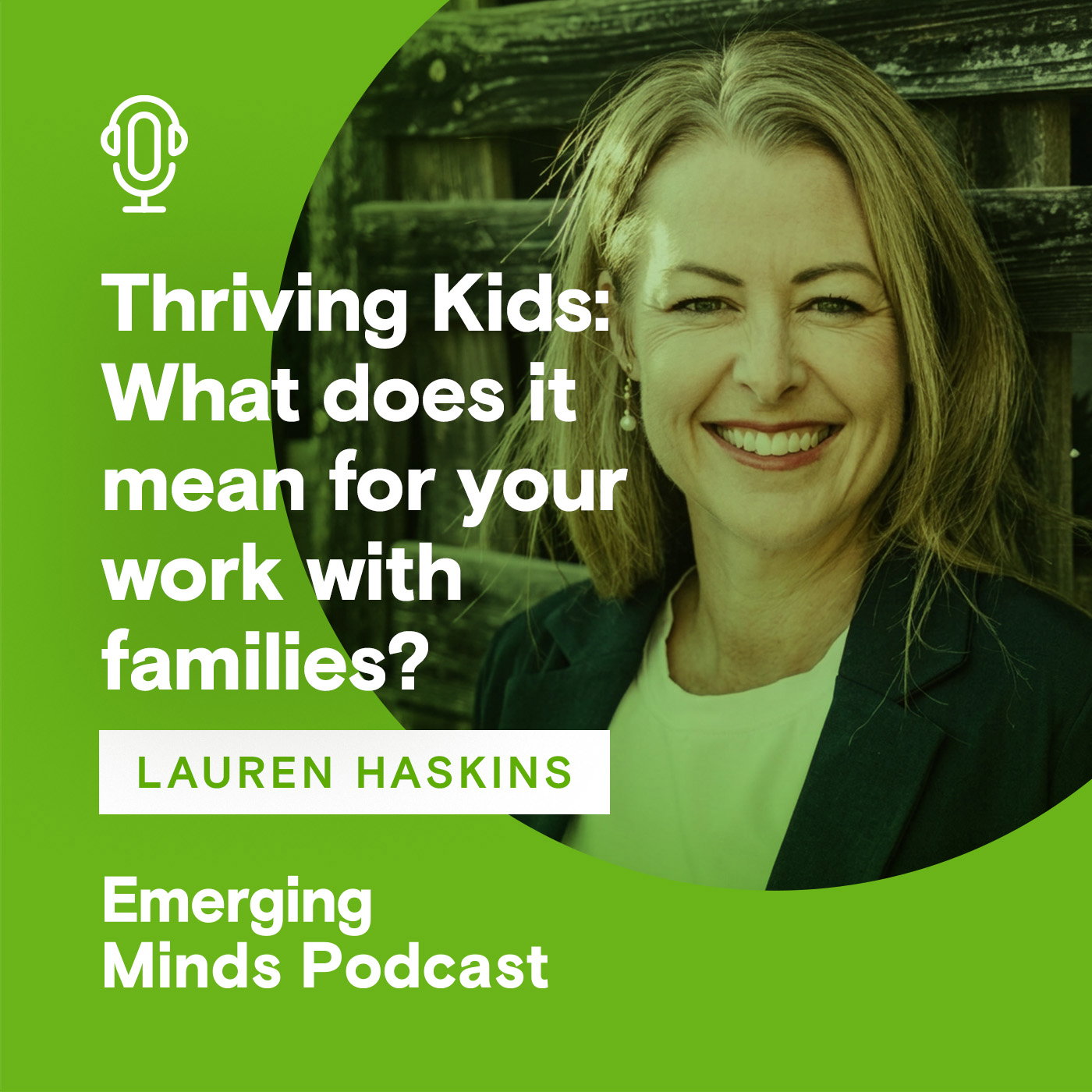
[00:00:07] Speaker B: Hi, I'm Jackie Lee and you're listening to the Emerging Minds Podcast. Before we start today's episode, we would like to pay respect to the traditional custodians of the lands on which this podcast was recorded, the Kaurna people of the Adelaide Plains and the Awabakal people of the Hunter region of New South Wales. We also pay respect to all Aboriginal and Torres Strait Islander peoples, their ancestors and elders past, present and emerging from the different first nations across Australia. I'm joined today by Lauren Haskins, a pediatric speech pathologist, business owner, Board Director of Speech Pathology Australia and winner of the 2026 Allied Health Awards Speech Pathologist of the Year Award. Over the past 20 plus years, Lauren has worked across public, private and not for profit settings. And in 2016, she founded her own private practice, A Growing Understanding, to support children and families in the Hunter Region of New South Wales. She is also the founder of let's Grow Together, which provides practical resources, professional development and community for speech pathologists and allied health professionals. A recognised advocate and speaker within the allied health sector, Lauren regularly contributes to conversations about workforce sustainability, emerging models of practice and disability reform. And she joins us today to discuss how she and her team are approaching the shift to Thriving Kids.
Hi, Lauren, thank you so much for joining us today.
[00:01:35] Speaker C: Thank you for having me.
[00:01:37] Speaker B: So, at the time that we're recording this podcast, we're about three weeks into the official rollout of Thriving Kids and I'm curious to hear what, if anything, has changed, both for you as a practitioner and for you as a service manager.
[00:01:53] Speaker C: Oh, it's the big question is
[00:01:55] Speaker B: straight off the bat
[00:01:57] Speaker C: and, you know, I'm going to be really direct throughout all of this, honestly. There hasn't been a huge amount of change day to day as yet. So the first phase is general support. So information, advice, a phone line and helping find services, targeted supports. Where allied health comes in is more happening in 2027 and NDIS access hasn't changed, so that's probably what hasn't changed, what we haven't really noticed too much of in the first three weeks. But what has changed is the conversation. I think families, referrers, early childhood educators, they're all asking more questions and there's a real gap between what's being reported and what is actually in place. And so a great deal of my time as a service manager has gone into getting clear on what is confirmed, what isn't and how we then explain it really simply and consistently to the children and families that we're working with, and then alongside that we keep delivering the work, which is the main thing.
[00:03:00] Speaker B: When we were chatting earlier, you mentioned that you were involved in the initial rollout of the NDIS as well.
I'm curious how that experience has shaped your approach to this transition.
[00:03:12] Speaker C: Yeah. So I think it's been such a learning curve for me. So I was fortunate to be invited to be a part of the DCJ Foundational Supports Advisory Group that occurred in New South Wales, because I'm based in New South Wales prior to the announcement of Thriving Kids that occurred in October 2025. And so I had already been meeting and been a part of that advisory and I was representing private practice. So I was one of two private practice representatives on that advisory group. So what we saw as part of that was we started to shift the way that those conversations were heading as a result of the Thriving Kids announcement. The biggest lesson is that big reforms often arrive unevenly and then they get refined. The first version is rarely the final version. We saw that in the early NDIS years and the information changed, the guidance changed, and families and providers were often hearing different things from different places. I think we're seeing the same thing repeating itself now as part of this big reform. I think what helped then and what I try to do now is stay calm and, and stay close to families and to be straightforward about what we know. I've also learned not to build too much on early rumor or speculation and not to wait for perfect clarity either. I've learned that it's really important to prepare for what's best. Very likely to eventuate. Like earlier support Family Centered Practice, our focus on a child's needs rather than their labels, without needing every detail of the funding model. So for me, I've started to think about what my documentation looks like in my service. How do we tighten and strengthen some of that?
I've really been looking at how we communicate with families around some of these reform changes and therefore how we also embed that family centered practice. So systems learn. And so I think part of our role is feeding back what we're seeing and doing so in a really constructive way. And so it's not just sitting and watching as the system evolves, it's about being an active contributor in that reform process.
[00:05:47] Speaker B: Absolutely. That's such great advice. And I'd like to sort of build on that by asking, how are you and your staff supporting families to manage the anxiety and the uncertainty associated with this transition?
[00:06:02] Speaker C: We know that a lot of families are receiving their information via social media. And I'm very conscious of not adding to the noise that exists in that space, but at the same time wanting to provide my opinions, my insights into that. So we do share information on social media, and then for our families that we're working with day to day, we try to provide that information through the documentation. So where I'm saying that we've shifted the way that we're reporting and how we are communicating some of these changes, there has been a shift in some of the wording that we use around our recommendations and then speaking to our families about why they're noticing this shift or why we're feeling the need to make those changes. So I think doing it at a. A1, on one level with our families is really important and to make it individual to each family and specific to their needs and also where they're at in that journey. But then more broadly, sharing with our community in a way that's accessible to them and social media being the most accessible way. That tends to be where we're wanting to feed out a lot of that information, as well as things like our blogs and our email updates and trying to make that information as accessible as possible. So I think it's a balance of widespread information sharing, but also making it individual and specific to family so that they're not having to manage too much excessive noise that's not relevant to them. And I think that that's probably the other thing is in terms of adding to the noise because there is so much uncertainty, we need to be very cautious of what we're sharing and when we need to make sure that what we're sharing is certain before we're sharing it or just sharing that we don't know is also okay as well, I think. So there's some of the ways that we're trying to approach that.
[00:08:01] Speaker B: I think that's such an important reminder that it is okay to not know and to sort of let families know that you are walking alongside them on this journey. And I can see that that's where the calm that you talked about earlier would be so valuable for famil families who are perhaps feeling less calm, more uncertain about all of this. There's still a lot we don't know about how thriving kids will work. But we do know that the involvement of allied health professionals working in private practice will vary significantly from state to state. What do you see as your role in supporting children with developmental differences and delays sort of moving forward as this program unfolds?
[00:08:50] Speaker C: My sense is that the shape of the role will differ depending on where you are. And I wouldn't want to assume private practice has one set place in every state.
So here in New South Wales, we're watching how the model is taking shape and we're keen to be a part of where it will make sense.
I'm confident that our core contribution doesn't change. I think, particularly in the last decade, we've. We have such an incredible workforce that has contributed to this population and to this demographic, and so I think we understand how a child communicates and how that fits into everyday life and we help the adults around them support it. And obviously I'm speaking from a speech pathology perspective rather than more broadly allied health. In a system with less emphasis on diagnosis, that becomes even more useful, not less useful. So in practice, I see us doing early identification alongside families and early childhood services. I see us doing functional assessments that asks what a child is trying to do and what's getting in the way. Parent coaching and group programs, consultation with educators and other professionals and supporting the move into school. So I see us doing a lot more of that in this space than what we ever have and I think that's where we need to be shifting our service and thinking about how we can be doing more of that. Now, if you are already doing those things, how are you going to strengthen that to make it even stronger than what it currently is?
[00:10:37] Speaker B: The aim of thriving kids is to provide earlier community based support and remove the emphasis on diagnosis as the only pathway to receiving support.
What do you think this will mean for allied health professionals? I feel like you've just touched on it there in terms of the way the work will shift.
But why might it be important for professionals to take a more holistic whole of child approach to the way they work with families?
[00:11:05] Speaker C: I'm a glass half full kind of gal. I'm generally quite optimistic, but I'm not naive and so I say it with a bit of caution. So. So for allied health, I think it's that shift from asking what's the label or what's the diagnosis? To asking what does the child need? And I think that this is how many of us already work or how many of us want to work. I'm expecting more consultation, more coaching and more working alongside early childhood educators, child and family health nurses, GPs, and more emphasis on goals and outcomes. I think it also puts more responsibility on us to describe clearly what we're seeing about a diagnosis. Rather than just giving a diagnosis, we're talking about what we're actually observing and the impact that that's having and so on that whole of child approach, communication and again, speech pathologists. So we're going to talk about communication and not other areas. But communication doesn't live on its own. A child's language is tied up with sleep, sensory processing, feeding, play, movement, emotional regulation, relationships, and what's happening at home and at the preschool. So if we only looked at speech sounds or if we only looked at the word count, we can sometimes miss the reason behind those things. And so it means that a child is less likely to be seen by four different people on what each of those are working on. And yeah, and so I think we need to think really broadly about the impact and the extent of the impact and what this actually means for the child and family. And so I think moving away from diagnosis as the only gateway doesn't mean that diagnosis has no place. Some families want a diagnosis and it can open up doors, but the aim is that it's no longer the only door to access services.
[00:13:11] Speaker B: At Emerging Minds, we talk about shifting from categorising children to sort of understanding their context that they're operating within. And yeah, I, I'm a glass half full person as well and I am optimistic about this.
It feels like a shift away from a pathological approach to infant and child mental health.
[00:13:36] Speaker C: I think you're right and I think the context is really important and I think priorities for the family is really important as well. I always like to speak with families about what does a typical day look like for them and where are the part that they really enjoy and where are the parts that they find really hard and it's the part that they find really hard a priority for them right now. And if it's not, does it need to be like, do we need to be thinking about that or focusing on it? And so I think context and also priorities are a big part of that whole of child, but I think whole of family is really important to think about as well. So I think having that information is where we really need to be looking at and focusing on one of the projects that I've been working on as a side hobby because I like to nerd out on technology. But I've been really looking at how we can help to visualize goals and outcomes and eco mapping for families. And I say visualize how can we document all of that and share that with them? That helps to bring out that context and those priorities a little bit more and be able to have that shared communication and shared understanding about what's important for families. So yeah, that's something that I've been working on because of all of this, that I think that's where we as practitioners need to be doing better in that space in terms of being able to think very holistically about children and families.
[00:15:08] Speaker B: I love a good data visualization. I'm excited to see where this side hobby takes you, what eventuates from it.
So you've talked a bit about the increased collaboration between services that is part of the new Thriving Kids model of care. How can practitioners effectively coordinate across systems to support families through this change?
[00:15:33] Speaker C: I think keeping it really practical is really important. So this is going back to that eco mapping. So I think asking families who else is involved, who are the main people in a child and family's life and with their consent, talk to those people. And I think having a summary, a one page summary in really plain language with goals, strategies, what's working, which a family can then communicate and provide to anyone that's involved with them is really helpful. Having an agreed number of small goals and shared goals rather than every service having different goals, I think is really helpful. And I think knowing the pathways well. So GP Child and Family Health, Early Childhood Services, Schools and then the NDIS Early Childhood Approach and now Thriving Kids phone line and State services. I think we need to be honest about the edges of what we do and who might be better placed to be able to support the child and the family. The families shouldn't be the ones having to hold that whole map. And I think they often are left holding that map and the responsibility of doing that coordination themselves. I think that as professionals, I think that we can hold that for them and through the right systems and the right documentation, we can ease that burden for families and we can take on that coordination role. So a habit that we're encouraging in the team is to ask before sending a report or a letter, we then also check with them about who else we can be sharing that with on their behalf. And hopefully we already know that information through a solid eco map and we're not relying on the family needing to share that and asking ourselves that question that would everybody who's receiving this document understand this and understand the context. So really making sure our documentation aligns with the purpose.
[00:17:33] Speaker B: Such great advice from families that I've spoken to. One of the most consistent messages is how tiring it can be to have to repeat your story and information across professionals. We know that families of children with developmental delay indifference often have quite a few people in their care team. So I love this idea of using Eco maps and other supporting documents to help alleviate some of that burden for families.
[00:18:04] Speaker C: I say this as a professional, but I also say it as a parent of an NDIS participant.
There is so much that can be done when you support a family with that coordination aspect. There are so many conversations that don't need to come via the family that can occur between professionals. And there are so many incredible technology platforms that exist now that really support the community around a child and a family to be able to encourage that coordination. I don't know whether I'm allowed to name drop some of my favorites, so one of the ones that I love is a platform, a program called Understanding Zoe. And Understanding Zoe has been built with this idea of coordination in mind. So we work with Understanding Zoe to be able to inform what they do, but it basically helps the family to be able to keep a track of all of the information from providers. It allows the providers to be able to talk to each other and to get updates and they also get updates from the family as well. So I use Understanding Zoe personally, but we also support professionally as well in terms of inputting evidence based practice in terms of that. And they're also utilizing some of the AI aspects to be able to generate useful tools for families. So I think the coordination aspect can be so helpful also for this thriving kids space that we're in. This is what's required in order to be able to ensure that families are getting access to the right services and being able to alleviate some of the burden that's on families as they try to navigate this really complicated system.
[00:19:51] Speaker B: I think it's great to be talking about the tools and the platforms that you've found particularly helpful. It can seem like a lot of additional work for practitioners, many of whom are already sort of trying to cram a lot into their days. So yeah, any guidance around what can make it easier, but also highlighting that it doesn't have to be another additional big workload to add on to your day, it's really helpful.
Do you work in health, education, social or community service sectors? Then have your say in the Emerging Minds 2026 National Workforce Survey for Child, Parent and Family Mental Health. You don't need to work directly with children or specialise in mental health to take part. We want to hear from practitioners and leaders across the country to help build one of Australia's most comprehensive pictures of the workforce supporting children and families. Head to our
[email protected] au for all the details.
We've talked about the uncertainty for families, but there are still so many unknowns for professionals as well. How are you navigating the uncertainty yourself and as a leader, how are you supporting your team to manage it?
[00:21:14] Speaker C: I'll admit it's uncomfortable. I don't think pretending otherwise is going to help anyone.
For myself, some of the things that I found particularly helpful is choosing a few reliable sources and checking them on a schedule rather than constantly. So I found myself particularly at the end of 2025 when there was very little information that I was constantly scrolling and I was being alerted to lots of things, particularly on social media. So what I like to do to be able to sort things into confirmed information and then, you know, what's likely and then what's speculated. So I use a lot of AI and so I've got a scheduled pulse on and it captures all of the updates in this area. I then check once a week, so it gathers it all in one place for me and then I'm able to review the credible sources that I've put in to be able to then keep on top of it, but not in an alarm, honest kind of a way. And also so that I'm not feeling like I'm constantly needing to be looking for this information, I plan for a couple of scenarios rather than worrying about all of them. And so I do a little bit of fact checking as well as, you know, planning for what might be coming. And I think for the team, I know that they can get anxious about change, and so my job is to settle rather than to raise the temperature. We do short, regular updates covering what we know, what we don't, and what it means for them.
They also know that if they're starting to feel their worries rise in this space, that they just ask and they ask for that regular update. So I'm really clear on what's changing, what isn't, and I make it easy to be able to ask those questions. I'm often saying, and we've used it quite a lot today, where I say, I don't know yet, you know, I don't know, but here's when I'll update you next. Or I don't know this, but this is what we do know. And with the clinical work, the things that we're good at always stays the anchor. So we know that we're good at working with children and families. That's what we're grounded in. And so we're always asking about how we can be doing that better in the context of some of these changes and things where we know where it's headed like what I mentioned earlier in terms of tightening our documentation for where this reform is taking us.
[00:23:41] Speaker B: I love that idea of anchoring in your practice, in your core offerings, and then using that to guide how you say anchor. And I'm immediately thinking about the ocean and sort of the waves and how it can be choppy and stormy and you just have to roll with it.
[00:24:00] Speaker C: It feels like that sometimes, I think too. And it can feel overwhelming. You can feel flooded by some of the information that comes out there and the anxiety with some of that too, because I think with uncertainty it can feel anxiety inducing sometimes. So I think we've been using anchoring. What are the things that hold us down and what's going to keep us on courses and things as well. So yeah,
[00:24:26] Speaker B: it's great that you've cultivated that team dynamic culture, I guess, where it is okay to ask questions and conversely it's okay to say I don't know, but when I do know, I'll let you know. As the landscape continues to shift, where are you going for reliable, up to date information? You mentioned your AI tool, but are there any sort of particular websites or social media accounts or anything that you're looking to.
[00:24:55] Speaker C: So the Department of Health, Disability and Aging, their Thriving Kids page is probably one of the main ones that I'm looking to that I use my professional association's Thriving Kids page. So Speech Pathology Australia, they put updates onto their Thriving Kids page as well as their other reform pages can be really helpful to be able to reference and to be able to look at about how they. This specifically shapes my profession, the NDIS website for anything on Early Childhood Pathways, our state government page. So as I said, each state and territory are going to be tackling this differently. And so for me in New South Wales, that's what I'm looking at. And so I would encourage people to look at their own individual state and territory page. On Thriving Kids, look to your own professional association. If you're not a speech pathologist, have a look at your own professional association about what they're putting out and what they're doing in this space and then having a local network of colleagues. So I've established our Newcastle and Hunter Early Childhood Interagency Network. This is a really important network of local colleagues where we compare notes, but we're also moving forward in our specific region about how we're going to be working with the early childhood population, how we're doing that now and how we are doing that as we're getting more information.
I also read the Raising Children's network hub, because that's what families are reading and I want to know what they're being told to make sure that the information that I'm sharing is aligned. But I think the main rule of thumb is to go to the primary source and also to check the date. Things are changing so rapidly, so it's very easy for things to get out of date. They're probably the main things that I'm really looking to. And that's why rather than having to, to take the time to go to all of those individual sources, having a system where all of that information can come to you in a summary. So for me it's my AI artifact, but I think having a system where you're getting updates on that information can be really helpful rather than you having to feel like you're constantly needing to seek to stay updated.
[00:27:09] Speaker B: Absolutely helpful. Sort of from an emotion regulation perspective, but also from a time perspective perspective. You've mentioned that you're a glass half full kind of person. I've noticed a lot of the discourse online around thriving kids can trend towards the negative.
So I was just curious about how you maintain that hopefulness about this change.
[00:27:35] Speaker C: I think that more broadly and what I've noticed and what the research suggests is that commentary online and particularly on social media tends to dip into to negative rather than positive. And so I personally and professionally try to limit my engagement in social media. I think it's really hard, you know, because in business you need to have a social media presence. And I think some would say that I've got a quite a big social media presence. But probably where it differs is that I don't like to engage in the discussion too much. So it's not about me pushing my optimism and my positivity because sometimes that can attract a whole other wave of negativity and yeah, a wave of attention that's not needed. So I tend not to engage in those forums and interact with the negativity I would prefer to have. And this is my approach generally I prefer to have a conversation and I would prefer to be able to have an in person or online conversation with somebody to get my certainty and to be able to get my understanding of situations. And I think being an optimist and being glass half full, I come with a lot of these situations, thriving kids, or more broadly professionally with curiosity. And so if I don't understand something or if something doesn't align for me, then coming at it with curiosity and asking questions rather than making comments.
So that's probably how I engage with it. And if something doesn't seem quite right to me or I don't understand it, I might feel overwhelmed by it. But the way that I combat that is to be curious about it, to get a better understanding about it and then what is going to be my actions from that? So I'm very action orientated. So what does that actually mean for me or what do I actually need to do in order to be able to address that? That. So I think that's probably the big thing we've spoken about, sitting in the uncertainty and saying we don't actually know, but what do we know and what can we be doing based on what we do know? So they're probably the ways that I approach that and it's a balance. Yeah,
[00:29:52] Speaker B: you mentioned there the uncertainty, like sitting in the uncertainty. Learning to do that is a whole skill in and of itself. I think society encourages us to lean on social media to do the exact opposite it distract ourselves. What is the one key thing you'd like listeners to take away from this episode?
[00:30:12] Speaker C: Hard to narrow it down to one thing. I think probably the biggest thing that came up in our conversation is that anchor. So staying close to the child and the family in front of you policy will continue to keep moving and the details will get clearer to us over the next year or two. We'll adjust as we go.
But what doesn't change is that a family comes to us worried about their child and our job is to help them feel informed and supported and that they're not on their own. And so I would say be informed, not alarmed. And that's the approach that I'd encourage for families and for us.
[00:30:52] Speaker B: Amazing. Thank you. And finally, where can listeners find you online?
[00:30:58] Speaker C: So LinkedIn is probably the best way to be able to find me and, and I need to be a little bit more present at posting online, but LinkedIn is probably the best way to be able to find me. So Lauren Haskins on LinkedIn, also on Instagram, I've got a personal page that I post some things on occasionally. So I think that the handle for that is LaurenHaskins au
[00:31:27] Speaker B: great. We'll include links in the show notes and also to your blog through your book practice as well. Thank you Lauren. It's been such a pleasure speaking with you today. I hope that this conversation can help any practitioners, professionals listening to feel, if not less uncertain than at least less alone in the uncertainty that they're feeling around thriving kids.
[00:31:53] Speaker C: Thank you.
[00:31:55] Speaker A: Visit our website today@imersion emergingminds.com to access a range of resources to assist your practice.
Brought to you by the National Workforce Centre for Child Mental Health, led by Emerging Minds. The Centre is funded by the Australian Government Department of Health, Disability and Ageing under the National Support for Child and Youth Mental Health Program.
Sam.