[00:00:00] Speaker A: It's not about changing the baby, it's about changing the environment so they can learn those elements that are going to be critical to their long term happiness and wellbeing.
[00:00:11] Speaker B: Welcome to the Emerging Minds podcast.
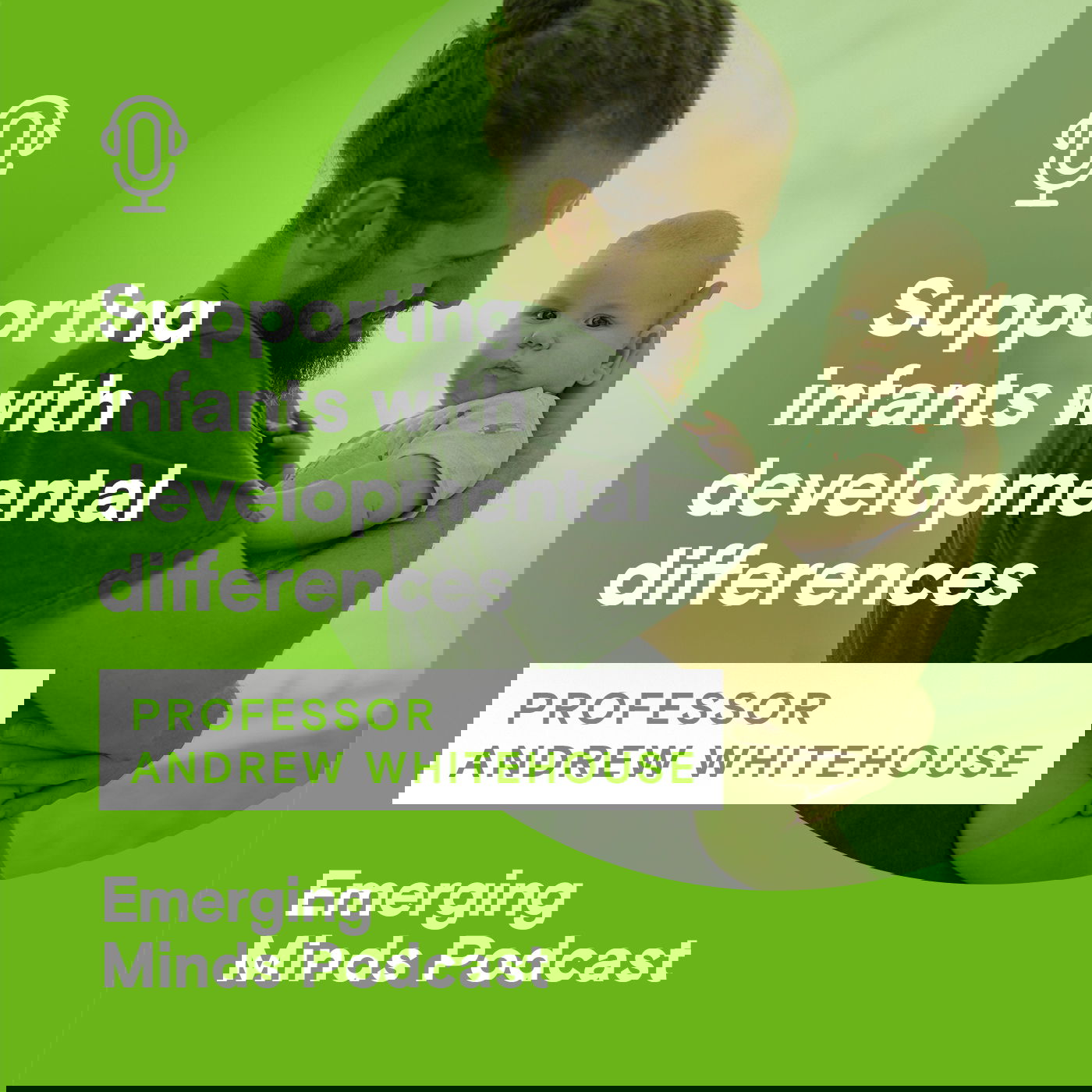
Hi everyone, my name is Jackie Lee and you're listening to the Emerging Minds Podcast. As we begin today's episode, I'd like to pay my respects to the traditional custodians of the land on which this podcast is on based being recorded, the Kaurna people of the Adelaide Plains and the Whadjuk Nungar people of Perth. I also pay respect to all Aboriginal and Torres Strait Islander peoples, their ancestors and elders, past, present and emerging from the different first nations across Australia and recognise the tens of thousands of years of caregiving wisdom they hold. I'm here today with Professor Andrew Whitehouse, Director of Clinikids and Deputy Director of Research at the Kids Research Institute Australia.
Welcome Andrew. Thanks for joining us.
[00:00:58] Speaker A: Thank you so much for having me.
[00:01:00] Speaker B: So to start, could you please introduce yourself to our listeners and tell us a bit more about your work?
[00:01:08] Speaker A: I mean, my name's Andrew Whitehouse, I'm Perth born and bred and I sort of, you know, grew up in the world thinking about ways in which I could, you know, enable others to have the gifts that I've been given in life in terms of where I've been born, the family in which I've been born to, and the ability to affect change in the world. And so I chose a path towards clinical life. So I originally trained as a speech pathologist, but I have to say I was utterly useless at that. So I retrained as a scientist pretty quickly and fell into the area of kids, kids developing differently really early in my clinical life. And I got utterly addicted to, to that connection between parents and kids. And it's an addiction I never wanted to shake. And so I've sought a career in science to find out new ways in which we can help parents and kids connect with each other and to help those babies and kids be whoever they want to be in the world.
[00:02:13] Speaker B: You mentioned there that connection between babies and parents, which I understand is the focus of the Inklings program. Can you tell us a bit more about that program, why you developed it and what the aims are?
[00:02:29] Speaker A: Yeah, look, absolutely.
In the area of kids developing differently, we talk about a clinical pathway which is essentially how kids progress through health and medical systems when they're developing a bit differently. Now, when I was practicing clinically and certainly when I see in my sort of scientific life, typically we identified babies Developing differently really early on, often in that second six months of the first year of life.
But we don't typically start to actually provide clinical support until about age 3, 4 or 5 years of age, because that's the first point that we can go very clearly that this is a diagnosable difference. Often autism is the diagnosis and that diagnosis is the catalyst, so the start of clinical support. But of course, all of those amazing brain building years happen in the first couple of years of life. And if you've ever seen a child develop language, you know just how incredible that brain is. But that clinical, the clinical pathway that I described just wasn't taking advantage of those amazing brain building years. So what the Inklings program sought to do was to actually try to heed the call of parents who are saying that actually we know very early on our baby's developing differently. And can we have a support, can we have a program that empowers us to support our babies at home? And that's what the Inklings program is. It's helping to identify babies developing differently very early on, between 6 and 18 months of age, showing early social communication differences. We can't diagnose anything that age. It's really just a delay or a difference in their development. Some of those babies might eventually be on a path for autism, but not the majority. And so this is about providing support that empowers parents to build a social environment around the baby that helps the baby develop in the way that's best for them. And through a clinical trial process, we found that that is actually incredibly powerful in building that connection between the parent and the child and ultimately supporting that child's development.
[00:04:28] Speaker B: Yeah, so I've read that the program is baby led. Can you explain for us what that means and why it's important?
[00:04:37] Speaker A: Oh, it's so important.
Adults are the boss of their kids in life, but in terms of play, kids are the boss. And that's the way that we sort of have to approach it, is that whatever the kid wants to do at that age, between 6 and 18 months in play, that they're the boss. The way that babies learn about the world is through play. They explore. So they sort of test the boundaries of their own independence, they test their own motor movement, they test their understanding, their problem solving skills, they test their social initiation, their communication, all of that comes through play. That's how babies learn. Now, so often when a baby's developing differently, they're interacting with parents in a slightly different way to what we typically expect. And so there's a Very natural instinct of humans to be more directive to get in there and tell babies, go this way or this way or this way. And we, that is, that is parent led play. That is us telling babies, babies how to play. But what the Inklings program is about is saying that the babies are developing differently and maybe they're not going to learn in the way that we as adults think in a neurotypical way might be best to learn. And so we follow that baby, baby led play. Then maybe we structure an environment around the baby that's actually best for the way that they learn, that individual baby learns. So it's essentially taking note of the baby, letting them do what they want and us building ourselves around their intentions.
[00:06:02] Speaker B: And what techniques does the program use? Like what does a session of Inklings look like?
[00:06:09] Speaker A: Well, the most powerful technique we use, and it's a little bit icky when I say it out loud for parents, is video. Video feedback. Now, there is very few more powerful insights into parenting than watching yourself interacting with your baby on video. So it's a very structured program. It's 10 sessions over about five months. So fortnightly sessions. And each session unfolds in a really sort of charact, characteristic and typical way. But generally speaking, what we seek to do is to film parents and then play that back in a really structured way and provide very key pieces of feedback at certain times.
Generally speaking, what we seek to do is to help parents with three messages. Number one is how important they are to their baby's development. We have families coming to us where the parents are feeling, oh, I'm not too sure if my baby's too fond of me, because the baby's interacting with them in a slightly different way to what they typically expect. Through video feedback, we can show very clearly just how important that parent is to the baby. You know, just a simple example is the baby might be sort of crawling away and they might look back at the parent and you just pause it there and you just sort of say, the parent. Do you see? You are the most important person in your baby's life. You are the son around which your baby revolves. So that's the first thing that you are so critical to their development.
Secondly, that your baby is communicating with you just in ways that you didn't expect. Through their body language, through their facial expressions, through their vocalizing.
All of that is communication trying to grab your attention. The third thing is how that parent can structure the environment around the baby to help the baby develop in a way that's best for them.
To help the baby learn in the way that's best for them, not in the way that's best for us.
[00:07:55] Speaker B: It sounds lovely. Very affirming for parents who might not necessarily know what to look out for because as you mentioned, they have these kinds of neurotypical ideas of how babies behave and respond in these relationships.
Before we go any further, could you explain for our listeners what you mean when you talk about social interaction and communication development?
[00:08:21] Speaker A: You know, when I think about social interaction and communication, I always go back to these amazing studies that have happened sort of, you know, over the last 20, 30 years. All took place within the maternity ward, that when babies are born there were these experiments that showed that babies look at the face more than they look at arms, they look at the eyes more than they look at ears. You know, babies are born knowing that social interaction and communication are the most important things that we will ever do. Social interaction, communication is hardwired in all of us. It's just that for some babies it happens in a different way.
So really from the earliest moments, babies interact, they use their eye contact, they use their body language, they use vocalising, they use gaze. All of these things is communication.
And actually you can have whole non verbal, 8, 10, turn back and forward communication just through the use of body language and eyes. And as I mentioned that some babies typically go through a path all the way through to learning words and then sentences, but not all babies and sometimes they're interacting in a different way and maybe that non verbal communication will last longer than we expect. Typically what we help parents to understand is that that is still communication, that your baby is desperate to communicate with you. What we help parents do is to read their baby's mind to understand what their baby's intention is so they can then be a good communication partner.
[00:09:50] Speaker B: Back you mentioned their things like eye contact, vocalisations, body language. What might a parent notice that suggests their child may have some differences in these areas?
[00:10:02] Speaker A: You know, one thing that's a really important thing to say, that development happens at all different paces for different babies. Milestones are super, super important, but they can also be really miss misleading because they say that by 12 months all babies should be standing or walking. You know, it's an important marker to have, but it can also sort of raise the anxiety around, you know, because of course there's variation around that. So what we tend to look at is a cluster of behaviours. So let's take a 12 month old baby. Typically what we'd be expecting is that baby is able to respond to their name. Just not, not necessarily, you know, through vocalising, but through a switch of attention when the baby hears their name. We'd be expecting babies to be able to imitate certain things. You know, imitation's so important for how we learn. So wait, bye, bye, clapping hands, those kind of things. We expect a certain degree of eye contact because eye contact, again, is another way that babies learn. That's not to say that it's, it's the only way, but it is an important way in which babies learn other things, such as showing parents things because it interests them. You know that, oh, look at this toy, Mum, look at this toy, dad, take a look at this. Now, all of these in and of themselves, one offs. If we're not seeing that, it's nothing for us to raise our kind of attention. But if we start to see 3, 4, 5 of these different behaviours within the same baby, not being a parent, then we start to go, let's provide this baby a little bit more of attention than otherwise. So again, it's not one marker, it's a cluster of markers that help us identify the general developmental track of a baby.
[00:11:40] Speaker B: You mentioned before, sort of neurotypical ideas around development.
I'm wondering, how does the Inklings program align with the social model of disability and a neuroaffirming approach?
[00:11:55] Speaker A: Yeah, I think it's a great question because it's something that we had in mind all the way along the development process. So this is what we would call part of the new generation of supports where the co designing and the collaboration with disability community has been critical to how it's emerged. It's a medical model. Disability says that, you know, the impairment is with the individual and, you know, the individual needs to fit with society. What the social model does is flip that on its head and say that actually so much of the disability is being generated by a world that's not accommodated to individual needs. And that's essentially what the Inklings program is. It's saying that the baby is beautiful, however they come into the world. And what we need to do is structure an environment around the baby that is unique to them.
Let's change the environment around the baby that's unique to them to help them learn in a way that's best for them. So it's exactly responding to that social model where we're changing the environment to meet the needs of the baby.
[00:12:53] Speaker B: And that aligns with the neuroaffirming lens as well, that any kind of difference isn't a bad thing. There are all different Kinds of brains out there.
[00:13:06] Speaker A: Yeah, that's exactly right. It's spot on. And neurofirming approaches, it's about they're all different types of brains to be nurtured and cherished and not to be changed. And again, it's about actually let's change the environment so the baby learns in the way that's best for them. It's not about changing behavior, it's about adapting an environment to meet the neurotype. Now it's so. It so happens that actually when you change the environment to meet the neurotype, a lot of the sort of internal disability that we might see around, you know, disability and communication, for example, actually is reduced because of course the baby's learning in the way that's best for them. That's just a logical extent.
But at the core of the program it's not about changing the baby, it's about changing the environment so they can learn those elements that are going to be critical to their long term happiness and wellbeing.
[00:13:58] Speaker B: So I had seen some concerns raised online that the program encourages masking in babies and aims to reduce autism diagnoses. But it sounds like that's not the case.
[00:14:10] Speaker A: Oh gosh, no, not at all, not at all. And in fact the program has been really very much co developed along with our autistic colleagues all the way.
A couple of things to say there is that firstly, babies can't mask. Babies are young and intentional beings and simply don't have that ability to mask. We've done some consultation work with hundreds of autistic colleagues across the world and collaborators across the world. And at the core of the sort of the desires of our autistic colleagues has been about developing interventions and supports that are actually about that, about nurturing the baby as to how they are and changing that environment around the baby.
[00:14:51] Speaker B: What are some of the key findings that have emerged from the Inklings trials in Western Australia and now South Australia?
[00:14:59] Speaker A: Yeah, well, so what's led up to the implementation pilots in WA and South Australia is a couple of clinical trials that were one that was taken in the UK and one that was happened in Australia. And again there were replicated findings there. Which is the gold standard, you know, gold standard in science is doing clinical trials and then doing replicated trials so you can understand whether those findings can be repeated across time. And that's what happened in this case. And what we found is that it supports that parent child connection, that there is a stronger parent child connection which comes out during those sort of, you know, beautiful one on one play times, but also supporting longer term reductions in social and communication disability so the baby is able to interact with the broader world with greater capability.
They were if they didn't receive the program. And that was replicated in a couple of clinical trials. So it does reduce those longer term disabilities that provide also short term disability because it was measured up to two years post the end of the program that do provide barriers for longer term development. Now those trials provide the evidence that were the catalyst for the big implementation pilots that are happening in WANSA at the moment. And those data are now being collected and it'll be really important for us to understand that what we saw in the clinical trials when it goes out in the big wide world, do we also see those really impressive and exciting results.
So that still remains to be seen.
[00:16:28] Speaker B: Are there any plans to do sort of a longer term follow up study sort of beyond that two years post the program? Just thinking about when kids get into school, for example, and how complicated and challenging those environments can be.
[00:16:47] Speaker A: The longer term studies are the absolute utopia. They take enormous amount of resources over a long, long time. So the initial studies in the UK and Australia, we were funded and were resourced to follow kids up to two years after the end of the program. That in itself is pretty remarkable in the field.
Often the field really only studies people immediately after the end of the program. So we were really excited to in both trials, not just to be resourced to actually do that, but also to be replicated results up to two years after the end. Those trials were not designed for longer term follow up, but certainly the ultimate is to do those longer term follow up. What platform, what foundation does the Inklings program provide for, you know, those longer term outcomes in terms of school and beyond? So certainly that's on our radar.
[00:17:40] Speaker B: Well, maybe there's a rich philanthropist listening to this podcast who might want to get in touch.
[00:17:48] Speaker A: You know, I just want to make the point here is that in terms of childhood, you change the start of the story. You change the story. And, and, and so often in the area of difference and, and difference in early childhood development, we, we're really only coming in at chapter three or four and the ability to change that story at that point is, is limited. Now when I'm talking about story, what I'm talking about is the barriers in which that child is going to face in life. What we found through the Inklings program is by providing it earlier and at the time at which the parents and the child needs the most, you can actually set the child on a path developmental trajectory to reduce longer term barriers. You can't do that to the same extent. Once we if we only come in at chapter three or four. The ultimate is we want that child to have the same opportunities as every other child to be whomever they want to be. And by providing that support early in life, that's the goal.
[00:18:50] Speaker B: Did you know we have another podcast specifically for parents and caregivers? The Emerging Minds Families podcast features conversations with practitioners, community leaders and lived experience advocates. Recent episodes have explored masculinity, children's experiences of anxiety, and tips for talking to children and young people about pornography and consent. You'll also find a special parent focused conversation with Andrew to complement this episode.
Search for Emerging Minds Families in your favorite podcast app or head to emergingminds.com aufamilies for more information. Now back to the show.
Inklings is obviously centered on supporting children with developmental differences.
But how can the findings that have come out of these trials and eventually the pilot in wansa, how can those findings benefit practitioners work with infants and families more broadly?
[00:19:51] Speaker A: Well, for starters, by providing something that is clearly evidence based.
So much of our evidence based support is for children aged 3, 4 and 5 and up. We do have certainly therapy techniques that are often used in children younger than that, but they're not necessarily clearly evidence based or have gone through that clinical trial process that is so important for every area. You know, I'm really lucky to work in a medical research institute that has all sorts of areas of health and medicine. And it's really startling to me to say that the evidence in the area of early childhood is so much lower than we would expect from any other area of health and medicine. And I'm really firm on this, that we should expect and only accept the same levels of evidence that we do for other areas of health and medicine. Because this is not just about the safety of the child. It certainly that but it's also about this child has and this family has one shot at this, this is their life and we need to make sure that they have been provided every opportunity with our best guess. And that's what the evidence is. It's our best guess. It says that we've trialled this elsewhere and this is our best guess is what's going to support you. So in the area of practitioners, what Inklings does is through the clinical trials is actually say we've been through this process, we've collected the evidence, this is our best guess into how we support that child to make the best and the most of this one developmental epoch that they have right now.
[00:21:23] Speaker B: It sounds like some of the techniques that you're using could easily be translated into various sort of therapeutic modalities as well. Right?
[00:21:36] Speaker A: Yeah, look, I mean it's really important to say there's nothing rocket science about inklings. What we've done. This is just fantastic developmental science coupled with terrific clinical skill. And that's often what we see in clinical practice, but not uniformly. And so it does have applicability. But it's really important to have gone through that scientific process to understand that if it's delivered that developmental science and clinical skill in this way, in this context, with this safeguards, we have a high likelihood of a positive outcome.
[00:22:09] Speaker B: So we've talked a lot throughout this conversation about developmental differences and that idea of difference can be quite scary for parents. Right.
Especially when it comes to their child's development. How can practitioners address a parent's concerns in a way that's neuro affirming but doesn't invalidate or blame or shame the parent?
[00:22:30] Speaker A: Yeah, well, for starters, listen, listen what happens when we become practitioners is we see babies developing differently, dozens a week and it's during the hurly burly of life. It's, it's really. It can become challenging to always remember that that 60 minutes or 45 minutes that that family is spending to with you is perhaps amongst the most important 45 minutes that that parent has spent in their whole parenthood journey. And I know most clinicians are just absolutely brilliant at this. Sometimes it's really hard when we're racing between various things. So first thing is, listen to understand how important this conversation is to their parent, validate their concerns and that understand where that parent is at that particular time. We've got to meet kids and families where they are where they are right now and that might be at a stage where they are really to embrace difference in their babies. There might be a time where they're not. And what can we do with that child and family first in mind to help support them on the journey so that they that asset, that sort of superpower that I mentioned, that love between a parent and child remains first and foremost and we can use that and leverage that to support the child going forward?
[00:23:49] Speaker B: That flows nicely into my next question, which was around how does inklings help parents to recognise and maybe gently let go of any neurotypical beliefs they might be holding about how their babies should behave?
[00:24:04] Speaker A: Yeah, it's really tough because if we talk about, about in the context of neurodifference, it is absolutely fine. And okay for parents to have expectations of their child. You know, there's all these amazing scientific studies that study what parents expectations of kids are when the baby is still in the mum's womb. And having sort of gone through this a few times myself, we absolutely have expectations and that's, that's absolutely fine. And that's just human nature.
What we all encounter in one way, shape or form is a sort of hard meeting with reality when the parent, when the baby comes out. And sport is the most important thing to you. But at 3, 4 or 5, all they want to do is read books. Hello. That's my experience.
It could be on that level, it could be on the, the level of music, you know, it could be on all sorts of levels. And it can also be on the level of a really deep seated emotional contact and how that baby is developing because that is really at the core when it gets down to it. Yes, we might want our baby to play sport or to be musical or be academic, but ultimately what we want is the world to value them as much as we value them and that sometimes that can be clouded when we see our baby struggling so much. So I guess the message from me and also through the Inklings program is to help help parents understand early that difference is what children are.
No baby is the same. No matter if you know they're developing typically or not. No baby is the same. All babies need help in one way, shape or form. This is the area in which your baby needs a little bit of extra support and this will help them going forward. Your job as a parent, and it's really important for all of us, no matter how your baby's developing early on, is to meet your baby, how they come come. And we all struggle with that as parents at different times in our life. With parents of babies developing differently, it just so happens it comes a little bit earlier than others. And so how do we help parents on that journey? By first recognizing that it's okay that you had different expectations and then secondly helping them support them through that process to the point where they go, you know what, being a little bit different, it's not just okay with me, it's bloody brilliant.
[00:26:23] Speaker B: How are the insights gained from the Inkling sessions extended to the other important relationships and environments in the infant's life? We've talked about a key focus of the program being about structuring the environment around the child to suit their unique needs.
And obviously the program works with parents, but I'm thinking of early childcare settings.
[00:26:47] Speaker A: For example, we have to grapple with the idea that babies don't learn in the clinic, they don't learn when they're taken out of their environment, driven 10, 15 minutes, half an hour, an hour to a clinic, and the family's empowered with messages and off they go. That may have an effect. But in those early phases, what we need to do is support kids and families where they exist, where with the people, places and spaces in which they inhabit and interact every day of their lives. So it's about, you know, empowering parents within the home, but it's also in early childhood education and care, which provides a hugely important opportunity for equity in terms of developmental outcomes across different communities in Australia and across the world. And so how can we ensure that early childhood educators are empowered with the same message amidst the Hurleyburg early Take the time to invest in play, because that is exactly how parent and babies will learn. But not just in play, in play that is led by you.
But how do you create a space, the time, the attention, the energy to help that baby explore and for you to follow them and for you to be a passenger on that journey so they can do that play in the way that's best for them. That's really hard within an ECEC setting because of the hurly burly of dozens of dozens of kids. But that would be my message. How can we structure an economic environment to allow that within ECEC settings, then a workforce environment where educators are not just skilled, but empowered to give that time, space, attention and energy for that same baby led inquiry in play. That will be the building block of all development.
And it's tough, right? You know, we can't have centers operating at losses. But we also, at the same time, have to get to grips with all the science that we know in how kids develop. The soil in which kids grow is time, space, attention and energy in 2025. We've never been shorter on that in human history.
So what can we do to rebuild that in the everyday settings in which kids live? Yep, the home, absolutely. Time, space, attention, energy. Boy, is that short. Are we short of that in my household, and I'm sure the household of many listeners as well, but also in ECEC settings, how can we create a fertile environment of 8, 9, 10 hours a day in which kids can truly develop in the way that we're evolved to develop?
[00:29:31] Speaker B: We've spoken a lot about the Inklings program this episode, but I understand that's just one part of your role at clinic kids. Thinking about your research work more broadly, what are some of the most compelling findings you've made about autistic children's mental health and wellbeing and the wellbeing of their families as well.
[00:29:50] Speaker A: I think one of the clearest findings that we've had is that the holy grail in the context of the clinical support for autism. So how do we best support kids through a therapeutic sort of program to, to help them be whoever they want, reduce their disability barriers in life. The Holy grail is that kids present to us very differently. They can be a child at, let's say age 5 who doesn't have verbal language and might have intellectual disability all the way through to a child who's highly verbal and be very academic and everything in between. How do we best match that child and the individual characteristics of the child with the program that is best for them? That's the Holy grail. We don't have that answer yet. We don't have, have our first line, second line, third line sort of therapy support through which we sort of go through. But ultimately, I think the biggest thing that we found throughout our, and this is an active program of research, how do we develop that sort of personalized matching of therapies and support so families don't have to go through a trial and error approach.
But ultimately, the most uniform finding that we've had is that the most universally sort of strong predictor of child outcomes is the health and wellbeing of the family unit around that child is that what can we do to support that child, that family around the child, to support that child? The families start to crumble in terms of their sort of economic resources, their physical resources, their mental health, their passion, their energy, all of that kind of stuff. Then ultimately the environment around the child is going to suffer and the child, child outcomes are going to suffer.
So first and foremost, what we found is that the biggest predictor of a positive outcome for children is the health and wellbeing of the family. And that really boils down to that becoming a key therapeutic aim for everything that we seek to do.
[00:31:44] Speaker B: What message might you have for any decision makers who might be listening to this episode around how they can best support children and families who are showing developmental differences?
[00:32:00] Speaker A: Look, I think in terms of how our systems support kids and families, the biggest thing that our systems need to need reform in is to support kids and families for who they are, not what diagnosis they have.
What we've seen through our education systems around Australia, but also through the National Disability Insurance Scheme, is the sort of gravitation towards diagnosis. That diagnosis is an entry point for providing support that was not what diagnosis was ever designed to be. Diagnosis is there to help parental and the child understanding about the journey they've been on to that point, but also to inform clinical management going forward. It was never designed to be a threshold that if you meet this criteria then you get support.
But for understandable reasons that were once understandable but now really unforgivable, would have used diagnosis as a gateway that you get a diagnosis, then off you go to support. But what that's done is driven wait lists, which means that two families might need to wait two, three years on a wait list before often they receive any kind of meaningful clinical support. What we do know through neuroscience that that two to three year wait list in the context of a two year old child, two, three year old child, that's half their life, you know, by the time they get to five and that all of our, or so much of our wonderful opportunities to support that have gone past us. So what I think is the most important thing we can do is to actually treat families and kids in particular for how they come. If a child is developing differently and requires support irrespective of diagnosis, they need that support. They need it promptly and they need it through an evidence based lens. They need evidence based support at a time that they need it.
So I think that's the biggest reform that we can do is to remove diagnosis from our systems. Diagnosis is an important part of understanding the child and their development and also ultimately in the end for that child and the family to understand themselves. But in the context of early childhood, we need to provide kids support based on who they are, their strengths, their challenges, not on what diagnostic criteria they meet. We also know that actually not all, everyone would require this, you know, 10 session program. And so what can we do to embed the messages that you're important to your baby, your baby communicates with you and your job as a parent, amongst all the love and, and the survival needs that you need to support with that baby is to actually structure an environment for them to thrive socially and with their communication.
Those are important messages for every parent. And so often we get families saying that, oh look, every child, every family should have this. And I wish I had it earlier.
[00:34:49] Speaker B: Absolutely. To close the episode, can you tell us who is eligible for the Inklings program and how they can register? Register? Do they need a referral at all?
[00:34:58] Speaker A: Yeah, so babies, babies don't need a referral. You can self refer into the program, but certainly health professionals can refer as well. So if they go to that website, inklings.org au you'll see it all there.
[00:35:09] Speaker B: Great. We'll put the link to the website in the show notes as well.
Thank you so much for joining us, Andrew. It's been a pleasure chatting with you and I look forward to seeing what you do next.
[00:35:21] Speaker A: No worries. Thank you to you.
[00:35:22] Speaker B: Thanks for listening. If you enjoyed this episode, please subscribe to our channel, Leave us a rating or review or share the episode with a friend, colleague or family member. Take care and we look forward to seeing you next time.
Visit our website
[email protected] au to access a range of resources to assist your practice.
Brought to you by the National Workforce Centre for Child Mental Health, led by Emerging Emerging Minds. The Centre is funded by the Australian Government Department of Health, Disability and Ageing under the National Support for Child and Youth Mental Health Program.